Showing posts with label unusual construction. Show all posts

Baby Belinda by Linda Nanette Kelley (1984)


Baby Belinda is a baby doll about 12" tall. This pattern was designed by Linda Nanette Kelley, and published in the Summer 1985 issue of National Doll World Omnibook magazine. She is designed to be made from polyester double knit fabric with moderate stretch. The instructions specifically say not to use a very stretchy fabric. The maker is instructed to stuff her head and body section "VERY firmly."

Baby Belinda is a baseball-head style doll with head and torso in one piece, and separate arms and legs. A chin dart adds further shape to her head. She has mitten style hands. Her limbs are attached with large snaps, which is a very unusual way to join them. She has an applied nose and applied ears. Her facial features are drawn with a quilting pen and fine tipped markers. She has a few loops of yarn for hair.

Her outfit consists of a dress with eyelet trim and short puffed sleeves, matching bonnet, panties, and booties made of ribbing. She comes with instructions to make a simple patchwork quilt.

Although the steps to sew Belinda and her outfit are not illustrated, the instructions are easy to understand . Anyone with some sewing experience should be able to make her with no difficulty. Her very simple hair and drawn-on features make for a quick project.


Simplicity 6006 - Holly Hobbie Rag Doll and Wardrobe (1973)


Simplicity pattern 6006 makes a Holly Hobbie doll with her wardrobe. Several patterns have been issued over the years to make Holly, but this was the first one. It is dated 1973.


There is no size given on the pattern, but the doll makes up to be about 20" tall. She has an unusual construction in that her head is to be made from a sock, while the rest of her is regular woven fabric. Darts add some shape to her torso. She has mitten hands with stitching to indicate fingers, and flat soled feet. The maker is instructed to put two rows of running stitches around the doll's head at the level of her eyes. This is meant to give the head some shape. She has embroidered features. Buttons can be used for her eyes; or her eyes can be embroidered onto scraps of fabric that are then used to cover buttons, which are then attached for eyes. Holly has yarn hair steamed into curls.


Holly's wardrobe consists of a long slip and pinafore (made from the same pattern pieces), a long sleeved dress, bloomers, poke bonnet, and felt Mary Jane style shoes. The underwear has ribbon inserted into eyelet lace for trim.


I have seen several of these dolls made up, and in my opinion they are some of the ugliest vintage cloth dolls I've ever encountered. The shaping of the head, the embroidered covered button eyes and the French knot nostrils are just plain weird. But then again, some people like weird! For a pattern collector, this is certainly an unusual design.

Copyright 2015 by Zendelle Bouchard

McCall's 7560 - Hillbilly Stuffed Dolls Pattern (1964)


McCall's Pattern #7560 makes three "Hillbilly" dolls - Paw who is 17" tall, and Shorty and Pearl, each 12" tall. Designed by Virginia Black, they were clearly inspired by the popularity of "The Beverly Hillbillies" television series which was the number one show in America at the time.


These dolls are made with an unusual method that calls for their heads to be made from either pink jersey knit fabric or a women's pink ankle sock (instructions are given for both); while the rest of their bodies are made from woven fabric such as broadcloth. Both the large and small dolls have applied noses, choice of embroidered or drawn features, quarter-seamed torsos, mitten hands stitched to indicate fingers, and crewel wool yarn hair. The main difference between Paw and the kids is their legs and feet; Pearl and Shorty have one-piece legs and feet cut from black fabric to resemble stockings, while Paw's bare feet are constructed separately and then applied to his legs. Paw also has a beard made from the same yarn as his hair.


The clothing of all three dolls is simple to make, with the patches added to the pieces before the side seams are sewn. Paw and Shorty have "suspenders" made from piping cord or heavy twine. The dolls' hats can be made from burlap, cotton crash (?) or an old finely-woven straw hat.

These dolls are charming characters which evoke the pop culture of their time. They would make a great gift for a fan of the Beverly Hillbillies or bluegrass music.


The Paw doll pictured below right was made from this pattern, although the maker used muslin for the entire doll, rather than using knit fabric for the head as the pattern suggests. Paw's companion (Maw?) is made from the same pattern. Either the maker created her clothing and hairstyle, or there is another version of this pattern out there somewhere that includes the lady doll.


The dolls are tagged from Blue Ridge Hearthside Crafts Cooperative in Sugar Grove, NC. They are charming and well made. You can read more about them here: https://www.etsy.com/listing/712167937/blue-ridge-crafts-hand-made-cloth.


Butterick 16" Holly Hobbie Doll and Wardrobe patterns (1990)

In 1990, Butterick issued a pattern to make a 16" cloth Holly Hobbie doll wearing an old fashioned dress and floppy hat, and a separate pattern to make a wardrobe of clothes for her.


The doll looks fairly simple to make, but has some unusual construction elements. Her head is shaped with darts, and her yarn bangs are sewn to the top of the face piece before the doll is put together. The rest of her hair is applied after she is stuffed. Each arm is made with one piece of fabric; the back seam of the arm is more like a dart. Her shoes are sewn to the bottom of her legs to form her feet. She has a rear end shaped so she can sit. Her facial features are meant to be painted on, but you could embroider or draw them with markers as well.


The clothing pattern that comes with the doll pattern makes a dress with lots of gathers, and a floppy hat with bow. No underwear pattern is included.


The separate clothing pattern makes a jumper with blouse, bloomers and hat; a dress with bloomers, a coat and hat, and a nightgown with night cap. Everything is trimmed with eyelet ruffling. The sleeves, bloomers and night cap are all gathered with elastic. The buttons on the front of the coat are decorative only; it closes with snaps, as do the blouse and dress. The nightgown has a velcro closure.


The patterns both include iron-on transfers of the Holly Hobbie logo. It would have made much more sense to have the transfer for her facial features, or the design on her dress, rather than having to trace them from the pattern piece or paint them freehand.


Martha & George Washington Doll Patterns by Ella DeHart (1968)


Ella DeHart self-published many doll patterns in the 1960s and '70s. This pattern makes 12" George and Martha Washington dolls, with their complete outfits.


Martha Washington has a quarter-seamed head and torso, with separate bust pieces to be stitched on after her torso is stuffed. Her legs are shaped like heeled boots. She has mitten hands with stitching to indicate fingers. Her arms and legs are thread jointed. She has embroidered features and yarn hair.

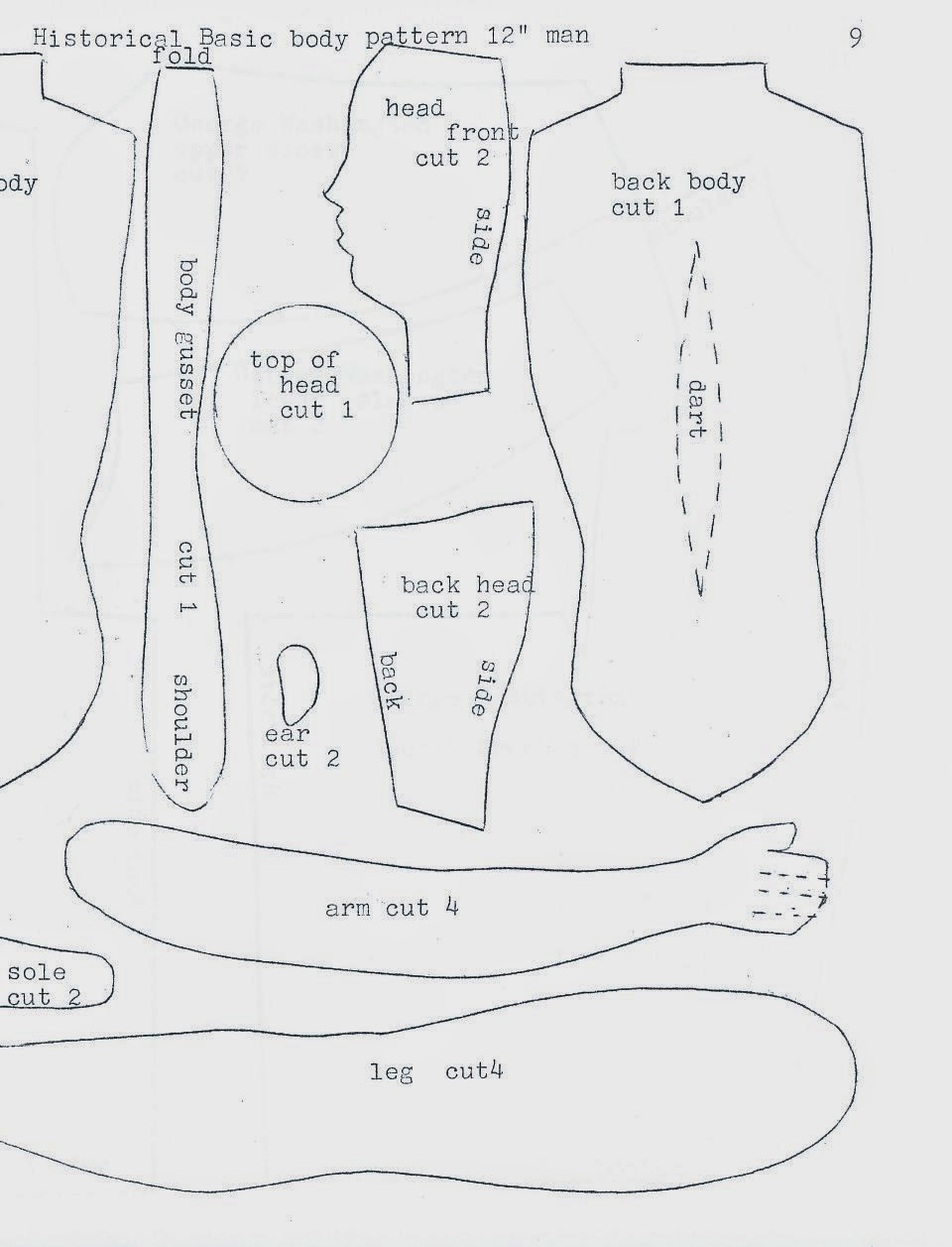
George has a somewhat different construction. His quarter-seamed head has a round pate piece and separate ears. His torso has a gusset that starts at one shoulder, goes down and around and up to the other shoulder. His arms and legs are thread jointed like Martha's. His hair may be a wig or yarn. The instructions call for both dolls to be made from felt.


Their clothing is detailed and mostly appropriate to the late Colonial / early Federal era in which they lived. Martha wears a dress with quilted underskirt and two petticoats. She also wears pantalettes, which were not introduced until after her lifetime. The instructions call for a bustle to be worn under the overskirt, in the middle of her back; the cover illustration instead shows a bustle on each hip, which would give the impression of panniers (side hoops), more appropriate to Martha's time, or at least to the way she is usually remembered. Her shoes are to be made of felt and cardboard, and she carries a fan you can make from paper and toothpicks.

George wears a shirt, stock (neckband) with lace jabot, knee breeches, hat, shoes and stockings. His suit and hat are to be made from felt. Personally I would skip the stockings and make his legs from white felt, as the maker is instructed to do for Martha.


Ella DeHart patterns are very interesting but she was notorious for the lack of detail in her instructions. You really have to know what you are doing to make one of her patterns. This one would be a nice challenge for someone who likes to make historical character dolls.

Marian Martin 9403 - 22" Girl Doll with Wardrobe

Marian Martin pattern #9403 makes a 22" girl doll with a nice wardrobe of clothes. It is not dated, but I am guessing it dates to the early 1940s. The pattern is the old diecut style tissue, unprinted, with holes to indicate the number of the piece and any markings.


The doll has a center-seam face, with multiple seams and darts in the head to give it shape. She has mitten hands and embroidered features. Her arms and legs are left unstuffed at the top, then sewn in place so that they are not exactly jointed, but do allow some movement. Her hair is wool yarn.


Her wardrobe consists of a slip and pantie, peasant style blouse, overalls and bolero jacket, and jumper and/or sundress. The sweetheart neckline of the jumper/sundress is a nice vintage detail.


All the instructions for this pattern, including cutting layouts, are printed on one side of a 15" x 19.5" sheet, so as you can imagine, they are not very detailed. (The reverse side of the sheet has "Practical Dressmaking Hints," most of which are not applicable to this doll.) And the unprinted pattern pieces are a challenge. The doll looks adorable, however, so if you are an experienced sewer, this one might be worth a try.


Simplicity 6141 - 21" Girl Doll with Lovely Old Fashioned Wardrobe (1983)


Simplicity pattern #6141 makes a 21" girl doll with an old fashioned "Little House on the Prairie" style wardrobe. It is dated 1983.


The doll has an unusual shaped head with lots of darts and seaming. She has a small, round, separately stuffed and applied nose, embroidered features and long yarn hair which can be styled a few different ways. She has long straight arms and legs, mitten style hands with stitched fingers and flat soles on the bottoms of her feet.


Her wardrobe includes a camisole, decorated with pretty pintucks and eyelet ruffles; bloomers; a dress with a high neck, gathered sleeves and ruffle at the hem, pinafore with decorative stitching on the bodice and pintucks on the skirt; bonnet; nightgown and mob cap.


This doll's large head and long, heavy hair might tend to make her head floppy without some internal support. But the clothing patterns alone make this pattern worth a try.

Ella's Original Doll Pattern #41: Cicely, Circa 1810 Bride Doll

Ella DeHart self published many doll patterns in the 1960s and '70s. Many, like this one, are Barbie-sized. Cicely is dressed as a bride in the Empire style of the early 19th century.


Cicely has a quarter-seamed head with ears, an hourglass torso with separate bust pieces to stitch over her body after stuffing, and a shapely bottom. She has stitching to indicate fingers. She is to be made of skin-toned percale, fine linen or any cotton. The maker is instructed to cut the head pieces on the bias to make the cheeks rounder. Hair can be darning thread, yarn or a wig; very little direction is given on this and style is left up to the maker. (A common hairstyle in this period was for the hair to be worn up, with little wispy curls around the face.)


Cicely's wedding outfit includes a gown with Empire waistline, pleated bodice, and overskirt with vertical gathers at the hemline; pantalettes and petticoat; veil, gloves and slippers. She should have a bouquet of tiny flowers. Although instructions call for the ensemble to be all in white, it should be noted that brides didn't always wear white at that time.


This pattern looks like it would be rather tricky to make, with a lot of detail on a relatively small doll. What do you think? Have you made one of Ella's patterns?


Fairy Tale Doll Patterns from the Marcy St. Doll Co.


This pattern makes three different fairy tale rag dolls from the same basic pattern. There are five 11" x 17" sheets included; one for the doll, one for the basic dress, underwear and shoes, and one page each to customize the doll as Red Riding Hood, Snow White or Alice in Wonderland. The pattern is copyright 1980 by Deborah Anderson, a cloth doll artist who ran her Marcy St. Doll Shop in downtown Portsmouth, NH for many years.


The doll has an unusual construction with a four piece head shaped by forehead darts; darts and inset arms in the torso; and a separate foot piece. The arms have mitten hands with stitching to indicate fingers. Facial features are embroidered, but buttons may be used for eyes if desired. Muslin is recommended for the dolls; their hair is made from yarn. The instructions are clear, but not very detailed. This pattern would be best for an intermediate sewer with some doll making experience.


Alice in Wonderland's pattern has a pinafore to go over her dress. Her hairstyle is straight with bangs. Red Riding Hood has a cape with hood. Her hair is styled in braids. Snow White's pattern has a long cape gathered with elastic at the neckline to form a collar. She wears her hair in curls tacked to her head.

This is an interesting, but hard to find pattern. I would love to see one of these dolls made up.


Vogue Pattern #2036 - Peter 'n Polly dolls


Vogue pattern #2036 is not dated, but I would guess it to be from the early 1980s. Peter and Polly are 24" boy and girl dolls made from stretchable knit fabric. She is dressed in old fashioned style, while he wears more contemporary clothing. A transfer is included for their faces.


Both dolls are made from the same body pattern. They have flat faces with small round stuffed noses. The backs of their heads are made from four sections, like the segments of an orange. Their torsos are seamed at the centers and sides, and have some shape. They have mitten hands and front seamed legs with flat soles. Arms and legs and stuffed first, then attached to the torso. The dolls have appliqued felt eyes and embroidered noses and mouths; Polly has embroidered eyelashes and freckles. Their hairstyles are created by stitching rug yarn to twill tape, then stitching the tape to the heads, and gluing the hair in place.


Polly wears a simple long-sleeved dress with eyelet ruffle trim, apron, petticoat and bloomers. Peter wears a long sleeved shirt, pants with rolled up hems, and a jacket with front zipper and appliqued sailboat motif. The  instructions called for hammered on snaps, and a zipper for Peter's jacket, both of which are unusual in doll clothing construction. Vinyl, synthetic suede or leather are recommended for their shoes. They wear purchased 3 month size socks.

These are fairly simple dolls, but with some unusual details. If you have made this pattern, please leave a comment and tell us about your experience.


Popeye, Olive Oyl & Swee'Pea mail order patterns 1979


Popeye, Olive Oyl and Swee'Pea patterns were issued in 1979, on the 50th anniversary of Popeye's debut in the comic strip "Thimble Theater" by E.C. Segar. The dolls are 16", 18" and 12" tall respectively. They were advertised in newspapers and magazines.

These dolls have some unusual construction details to make them resemble the original comic characters. All three have baseball style heads, but Popeye has a large chin piece added on and stuffed separately. Olive Oyl's torso is a rectangle with long thin neck, arms and legs. Their legs are constructed like pants, joined at the top. Swee'Pea has curved legs under his sacque. All have applied noses and felt eyes. Their other features, including Popeye's tattoos, are embroidered. Olive has yarn hair. Instructions to make Popeye's pipe and spinach can are included.

The instructions call for peach-colored nylon fleece or double knit to make the dolls. Popeye's body may be made from woven fabric rather than knit. Their clothes are made to be removable.

These patterns seem to be fairly common and are widely available as photocopies, despite being technically still under copyright. The lack of a date on the pattern, or any copyright information, may lead some to think they are older than they are.

Dolls that I have seen made up from these patterns are a couple of inches taller than what the patterns indicate. Not sure if the patterns are sized incorrectly, or it's caused by the stretching of the knit fabrics used to make them. Also, the heads seem to come out elongated rather than round. The maker of these dolls did a great job. I love the fiberfill "smoke" coming out of Popeye's pipe. Doll photos courtesy of ebay seller peggylbyrne.


Little Vogue #1336 - Big Headed Boy & Girl dolls


Little Vogue #1336 makes a 32" boy and girl doll with old fashioned daytime and nighttime outfits. This pattern is not dated, but probably was issued in the late '60s or early '70s.

The dolls have simple bodies but their heads are a little unusual. The face is one round piece, but the back of the head has extra pieces for shaping and they wrap around underneath the face piece to make a chin. Probably because of their large size, their entire bodies are lined with fusible interfacing. The dolls have flat feet (with cardboard inserts), mitten hands, tiny embroidered "O" mouths and large button eyes. Their yarn hair is in a simple style.

The girl's daytime outfit is a granny dress, fashionable at the time. The boy wears Little Lord Fauntleroy style suit and shirt. Both outfits are trimmed with eyelet ruffles. For nighttime, she wears a long nightgown, and he has two piece pajamas.

These dolls resemble the work of children's book illustrator Joan Walsh Anglund, author of "A Friend Is Someone Who Likes You," published in 1958.


Design 7340 - Old Fashioned Girl Doll


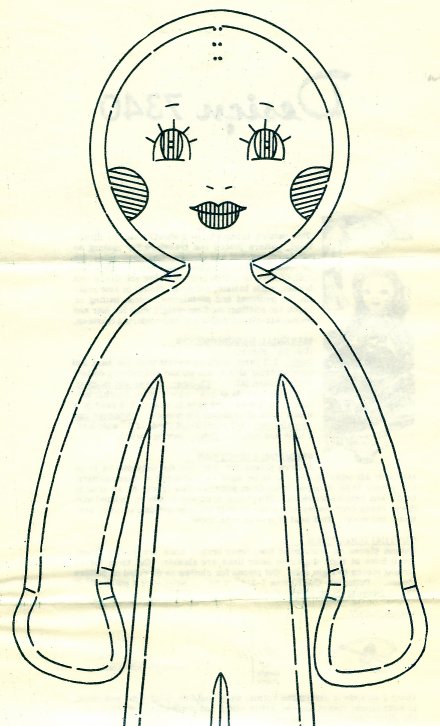
Design 7340 is a mail order pattern to make an Old Fashioned doll about 14" tall. The pattern is undated, but the instructions calling for kapok to be used for stuffing and wool for the hair implies it was issued in the '50s or earlier, before synthetics were commonly used.

The pattern and instructions are all on one sheet. The doll pattern pieces are a transfer, to be stamped on fabric and then cut out, but the clothing pieces are meant to be cut out and used like a tissue pattern.

One piece is given for the front of the doll and one for the back, but the instructions call for a strip of fabric to be sewn in between the two halves, all around the doll, to make her more three dimensional. The back of the doll's head has darts to give it some roundness. She has embroidered features and yarn hair. The instructions illustrate wrapping the yarn around a pencil to make curls.

The doll wears a dress trimmed with self ruffles on the sleeves and ribbon bows, matching bonnet, petticoat and pantalettes trimmed with lace. Her shoes are embroidered onto her feet.

I love this doll's face. This is one I'd like to make.