Showing posts with label vintage cloth doll pattern. Show all posts

McCall's #4780 / UK60 - Wombles Doll Pattern (1974)


The Wombles are furry fictional characters from a series of children's books written by Elisabeth Beresford and originally published from 1968 to 1976. They live in underground burrows and recycle discarded objects in creative ways - what would be referred to today as upcycling. The stories were adapted into a BBC television series in the 1970s, and the Wombles also occasionally appeared in the US on the Captain Kangaroo TV show.

McCall's pattern #4780 (issued in the United Kingdom as UK60), makes a 12" doll with clothing and accessories to make up five different Wombles characters.


Construction
The instructions call for the Wombles body to be made of long pile faux fur with jersey knit face, ears, hands and feet. Buttons are to be used for the eyes and nose, with circles of felt for the whites of the eyes. The seaming is unusual and fairly complex, but there are no joints to worry about. The hands have stitched lines to indicate fingers.


Clothing
The clothing pieces are to be made primarily of felt, except for Uncle Bulgaria's tartan costume. Knitting instructions are given to make mufflers and a scarf. Spectacles and walking stick are made from pipe cleaners wrapped in felt.


Notes
The Wombles are cute and their story line makes them even more interesting. I question the recommendation to use jersey for parts of the dolls, as it seems too lightweight and stretchy unless you are stuffing very loosely. I would go for a heavier, more stable knit. The pattern calls for the doll to be stuffed with kapok, but that's expensive and not easily available these days, so fiberfill (recycled, of course!) might be a better option.

Find Wombles patterns on eBay!


Simplicity 6006 - Holly Hobbie Rag Doll and Wardrobe (1973)


Simplicity pattern 6006 makes a Holly Hobbie doll with her wardrobe. Several patterns have been issued over the years to make Holly, but this was the first one. It is dated 1973.


There is no size given on the pattern, but the doll makes up to be about 20" tall. She has an unusual construction in that her head is to be made from a sock, while the rest of her is regular woven fabric. Darts add some shape to her torso. She has mitten hands with stitching to indicate fingers, and flat soled feet. The maker is instructed to put two rows of running stitches around the doll's head at the level of her eyes. This is meant to give the head some shape. She has embroidered features. Buttons can be used for her eyes; or her eyes can be embroidered onto scraps of fabric that are then used to cover buttons, which are then attached for eyes. Holly has yarn hair steamed into curls.


Holly's wardrobe consists of a long slip and pinafore (made from the same pattern pieces), a long sleeved dress, bloomers, poke bonnet, and felt Mary Jane style shoes. The underwear has ribbon inserted into eyelet lace for trim.


I have seen several of these dolls made up, and in my opinion they are some of the ugliest vintage cloth dolls I've ever encountered. The shaping of the head, the embroidered covered button eyes and the French knot nostrils are just plain weird. But then again, some people like weird! For a pattern collector, this is certainly an unusual design.

Copyright 2015 by Zendelle Bouchard

McCall's 8349 - Boy and Girl Dolls in Two Sizes (1982)


McCall's pattern 8349 makes a boy and girl doll in 17 1/2" and 13" sizes dressed in old fashioned styles. The pattern is copyrighted 1982.


The dolls are made with a simple body in separated pancake style, with contrasting color feet to look like shoes, and mitten hands. The head has a flat face with a separate round stuffed nose; and the back of the head is in three pieces to give it a rounded shape. The girl and boy dolls are made with the same pieces, the only difference between them is the embroidered facial features, and the yarn hair styles.


The girls' lace-trimmed dress can be made long or short. For the longer version, there is a pinafore and mob cap to give her a "Little House on the Prairie" look. The shorter version, without the pinafore, looks more contemporary. The boys' outfit is a shirt with gathered sleeves, pants with elastic waist, and a vest. These pieces could be used to make another girls' outfit as well.


Although there is nothing unusual or exceptional about these designs, but the dolls are cute and the clothing patterns adaptable to a number of different looks. The instructions for this pattern are detailed, especially the page on hair styling, so this looks like a good pattern for a less experienced (or less confident) sewer.


Copyright 2015 by Zendelle Bouchard

Roly Poly Pincushion Dolls Pattern

This pattern to make a pincushion doll in two variations was designed by Janet C. Brandt and published in the November 1984 issue of Doll Reader magazine. The doll could also be made up as a child's toy.


No size is given for the dolls, but they look like they would make up at about 6" tall. The body is made in five or six segments to give it the rounded shape. The facial features are embroidered. Two examples are given as to how they could be finished, but there are many possibilities with these dolls.


 My main concern with the pattern is there is no method given for weighting the bottom so that the dolls would stand up straight, but it doesn't seem like it would be too difficult to figure that out. This is a cute pattern for a sewing room doll that could use up scraps of felt, fabrics and trims, and be decorated in many ways.

Copyright 2015 by Zendelle Bouchard

Painted Fabric Dolls from McCall's Needlework & Crafts Magazine (1970)


Leaflet No. 765-NB, published by McCall's Needlework and Crafts Magazine, is a pattern to make three painted cloth dolls. The dolls are simple pancake style, with elaborate designs meant to be made with ball point paint, also known as liquid embroidery. The leaflet is one sheet of 17" x 22" paper, printed on both sides.


The three dolls are named Elspeth, Amanda and Lilly. They appear to represent older girls in period costumes. Amanda and Lilly are each holding a doll. They measure about 15" tall. The maker is instructed to transfer the design of the dolls to fabric using tracing paper, pencil and carbon paper. These days it would be much simpler to scan the designs and print them directly on fabric. While the ball point paints would give good results, they dolls could also be hand or machine embroidered. The patterns could also be used in an embroidered or appliqued quilt or wall hanging.


I have never seen a cloth doll made with this technique, have you?


Copyright 2015 by Zendelle Bouchard

The Mad Tea Party - Alice in Wonderland Doll Patterns by Joan Russell (1965)


The November 1965 issue of Woman's Day magazine featured The Mad Tea-Party, a set of cloth dolls of characters from Lewis Carroll's "Alice in Wonderland," designed by Joan Russell. The magazine included free patterns on tiny grids for you to enlarge, or you could order the set of full-size patterns by mail. The full-size patterns are on six 17" x 22" sheets of paper, with black and white illustrations. No size is given, but Alice looks to be about 14" tall.


The Mad Tea-Party includes Alice, the March Hare, the Dormouse, the Mad Hatter and the White Rabbit. The heads and torsos of the dolls are sewn in quarters, with two piece arms and legs, jointed with buttons. The maker is instructed to make Alice and the Mad Hatter from cotton, the White Rabbit and March Hare from wool, and the Dormouse from velveteen. They have appliqued and embroidered facial features. The Mad Hatter's nose is stuffed to give it dimension. The hair and tails are of yarn.


Each character, except the Dormouse, has a simple version of his or her outfit, well known from the classic illustrations by John Tenniel. Alice wears a short sleeved dress, a pinafore with two pockets, and felt shoes. The Mad Hatter wears a sleeveless shirt, corduroy pants, jersey jacket, velveteen hat, felt bow tie and shoes. The March Hare wears a sleeveless shirt with simple tie, and a jacket. The White Rabbit's outfit consists of a sleeveless shirt, vets, jacket and bow tie.


These simple patterns in Joan Russell's signature style are simple to make, and will delight fans of this classic story.


Design 736 - Vintage Boy and Girl Sock Dolls Pattern


Design #736 makes a boy and girl doll from men's size 11 1/2 or 12 tan, white or flesh-color cotton socks. No publisher's name is on the pattern, but it appears to be a publication of Reader Mail, Inc., the company responsible for Laura Wheeler, Marian Martin and Alice Brooks patterns, among others.


The dolls have darts for shaping their bodies. The arms and ears are made separately and attached. They have embroidered features and "straw yarn" hair. The boy is given a sleeping face, while the girl is wide awake and smiling. No size for the finished dolls is given, but they look like they would make up to be about 12" tall.


The girl doll wears a nightgown and the boy a one piece pajama. If you wanted to make daytime clothes, the nightgown could easily be shortened to a dress, and the pajama to a romper.

The tricky part about making these dolls might be finding the right pair of socks. Men's cotton dress socks that have no texture or ribbing would be ideal.

Copyright 2014 by Zendelle Bouchard

June Bride 15" Vintage Cloth Doll Pattern


June Bride is a 15" cloth doll from the booklet "Dolls Old and New," which includes several cloth doll patterns. There is no copyright date or publisher's name on the booklet, but it appears to have been printed circa 1970, though individual patterns may have been offered at an earlier date. This may be a publication of Reader Mail, Inc., the company responsible for Laura Wheeler, Marian Martin and Alice Brooks patterns, among others.


June Bride is a baseball-head doll with attached ears. Her arms and legs are sewn in place so she cannot sit. Her facial features are embroidered after stuffing. Her hair is worsted weight yarn. She has mitten hands and flat-soled feet.


June Bride's wedding gown is a very simple one, with the bodice and sleeves all of one piece. The bodice is trimmed with lace and buttons to give the illusion of a yoke. She has a veil, petticoat and bouquet, but no underpants or shoes.

June Bride would be a nice doll to display a miniature-sized version of your own wedding gown.


McCall's 7560 - Hillbilly Stuffed Dolls Pattern (1964)


McCall's Pattern #7560 makes three "Hillbilly" dolls - Paw who is 17" tall, and Shorty and Pearl, each 12" tall. Designed by Virginia Black, they were clearly inspired by the popularity of "The Beverly Hillbillies" television series which was the number one show in America at the time.


These dolls are made with an unusual method that calls for their heads to be made from either pink jersey knit fabric or a women's pink ankle sock (instructions are given for both); while the rest of their bodies are made from woven fabric such as broadcloth. Both the large and small dolls have applied noses, choice of embroidered or drawn features, quarter-seamed torsos, mitten hands stitched to indicate fingers, and crewel wool yarn hair. The main difference between Paw and the kids is their legs and feet; Pearl and Shorty have one-piece legs and feet cut from black fabric to resemble stockings, while Paw's bare feet are constructed separately and then applied to his legs. Paw also has a beard made from the same yarn as his hair.


The clothing of all three dolls is simple to make, with the patches added to the pieces before the side seams are sewn. Paw and Shorty have "suspenders" made from piping cord or heavy twine. The dolls' hats can be made from burlap, cotton crash (?) or an old finely-woven straw hat.

These dolls are charming characters which evoke the pop culture of their time. They would make a great gift for a fan of the Beverly Hillbillies or bluegrass music.


The Paw doll pictured below right was made from this pattern, although the maker used muslin for the entire doll, rather than using knit fabric for the head as the pattern suggests. Paw's companion (Maw?) is made from the same pattern. Either the maker created her clothing and hairstyle, or there is another version of this pattern out there somewhere that includes the lady doll.


The dolls are tagged from Blue Ridge Hearthside Crafts Cooperative in Sugar Grove, NC. They are charming and well made. You can read more about them here: https://www.etsy.com/listing/712167937/blue-ridge-crafts-hand-made-cloth.


Baby Dolls by Joan Russell for Woman's Day (1964)


This set of patterns, designed by Joan Russell, makes a chubby baby doll which can be varied with different facial features and hair colors, plus a wardrobe of clothes. It was offered to readers of Woman's Day magazine in 1964.


The pattern is described as making five different dolls, but they all use the same pattern pieces. They are made in baseball head style, but unlike most dolls with this construction, the front face piece is wide enough so that the face is flat and the head more square than round. The baby's arms (with stubby, separated fingers) and legs are stuffed separately and then attached.By varying the embroidered facial features and colors of yarn hair and appliqued fabric eyes, the maker is instructed to make the characters of Sleepy Head, Angel, Red Head, Cry Baby and Cherub. No size is given for the dolls, but they look like they would make up about 16" tall.


The pattern includes a complete wardrobe of clothes to sew, including a smocked dress and bonnet with bloomers; coat and hat; underwear, bib and blankets; one-piece pajama and nightgown with drawstring bottom; bunting; christening outfit with eyelet gown, coat and bonnet; plus knitting instructions to make a sweater, bonnet and booties.


Joan Russell's dolls are fairly simple to make, and the outfits have some interesting details, like the smocked and knitted pieces. This is a classic '60s cloth doll pattern.


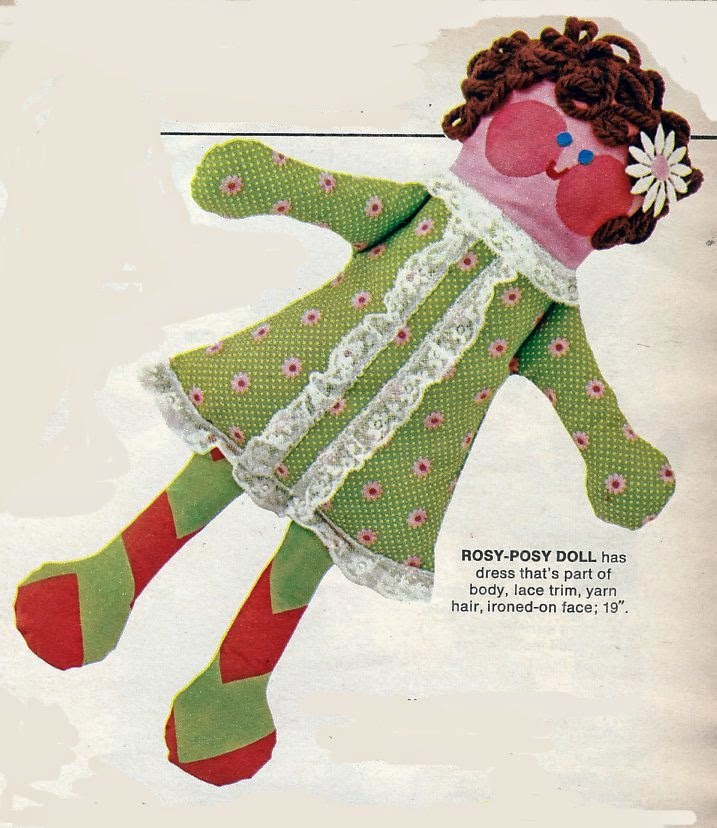
Rosy-Posy and Wide Eyed Suzy Dolls from Woman's Day (1968)

In the 1960s and '70s, Woman's Day magazine featured an article on inexpensive Christmas gifts to make in their November issue. Cloth dolls were always included. These two dolls, Rosy-Posy and Wide Eyed Suzy, were offered in the November 1968 edition. In addition, two Mother Goose dolls designed by Joan Russell were included in the same issue, with an order form to send away for patterns for the complete set of five.


19" Rosy-Posy is like a pancake doll, except that her front and back are pieced together from three separate fabrics first, then sewn together all at once. Her body and arms are made of print fabric to look like a dress, and gathered lace trim adds to the effect. The instructions call for brightly colored iron-on fabrics to be used for her facial features. I don't think these are widely available now, but with the advent of fusible web like Wonder Under and Stitch Witchery, any fabric can be used. Her hair is made of rug yarn.


Wide Eyed Suzy is a 12" pancake doll and meant to be made of felt, with glued-on eyes and mouth and embroidered yarn freckles and eyelashes. Her dress is also felt with appliqued felt dots, and she has yarn hair.


The patterns for both dolls are given as tiny grids which need to be enlarged to be used. With such simple designs as these, this method is easy enough, even without the use of a scanner or copier. These patterns would make great first sewing projects for young children.