Showing posts with label magazine. Show all posts

Handkerchief Fairy Doll by Nancy Porras (1985)


The pattern for this 16" cloth fairy doll, designed by Nancy Porras, was published in the April 1985 issue of National Doll World magazine. She is a separated pancake style doll, with each body part being sewn from an identical front and back, or right and left, piece.
Instructions for the Handkerchief Fairy doll call for her to be made from peach broadcloth, though you could of course use any color. She has small mitten hands with a long thumb, and her legs are shaped slightly bent, with her toes pointed, like a ballerina. She has pointed ears which are part of her head, rather than separately applied. Her face is painted with acrylic paints, but could easily be embroidered or drawn with markers instead. Her hair is made from two skeins of embroidery floss.


Handkerchief Fairy's only clothing is a dress made from a floral hankie. The one used for the pictured doll was 14" square. Satin ribbon forms the belt. She has no shoes or underwear. One unusual feature is the beaded tiara and necklace.

This is a fairy simple pattern, but her long thin arms and legs might be a challenge for a beginner to stuff smoothly. The instructions say "the doll and dress can easily be made in an afternoon," but that estimate would be for an experienced sewer, as the steps are not illustrated, and not explained in great detail. Those who enjoy dollmaking more than costuming will appreciate the dress that requires no hemming or closures. The beadwork is an interesting addition to this simple but unusual doll.

Chelsea, The Wood Nymph by Jeanette Amick


Chelsea, The Wood Nymph was designed by Jeanette Amick of Hayward, CA. The pattern was published in the June 1992 issue of Doll Life magazine. 

Chelsea is a separated pancake style doll. No size is given, but it looks like she would make up to be about 8" tall. She is to be made of unbleached or ecru colored muslin, with a painted face and Spanish moss for hair. Her face could easily be embroidered or drawn in place as well, and embroidery floss could be used for hair if you wish her to have a more conventional look.

Because she is such a small doll, the instructions call for the stitching lines of the body pieces to be transferred to the fabric and then stitched before cutting out the pieces.


Chelsea's fully-lined outfit includes a simple shirt and a skirt made of alternating small and large petals sewn to a waistband. She has boots with turned-up toes as well. Chelsea is meant to be displayed on a piece of driftwood with peacock feathers, as in the photo.

This pattern is suitable for a sewer with some dollmaking experience. Step-by-step instructions are given, but the steps are not illustrated, and a few steps seem to have been left out. For example, nowhere does it say to stuff the head, but obviously that needs to be done.


Her small size will appeal to those who like to make little dolls, and simple changes or embellishments to her face, hair and outfit could create a forest of different fairies. If you have made this doll, please leave a comment to tell us about your experience.


Laura Ingalls Doll by Alison Bushell (1985)


Laura Ingalls doll is 10 1/2" tall (27 cm) and was designed by Alison Bushell. The pattern was published in the Summer 1985 edition of National Doll World Omnibook magazine. Although the television series about Laura's life, Little House on the Prairie, was no longer being produced by the time this pattern appeared, the show was still being shown in syndication, and the books the series was based on were as popular as ever.


Laura is a baseball head style doll. The instructions call for her to be made from cotton fabric. The back of her neck is longer than the front for a slightly more natural appearance. She has mitten hands with stitched lines to suggest fingers. Her arms are sewn on with hand stitches at the shoulder. Her legs are sewn to the front of her torso, enabling her to sit.
Her facial features are very simple. The maker is instructed to sketch them on freehand and then stitch with embroidery floss. For her hair, the instructions call for the head to be covered with machine-knitting yarn in broad stitches, then a hank of yarn is sewn at the center part and braided. A few extra strands sewn to either side of the head give a more realistic look.


This pattern includes a wardrobe of old fashioned clothing including two dresses, an apron, petticoat and drawers, black stockings and side button boots, a sunbonnet, straw hat, fur cape, wool hood  and knitted mittens. Laura also has her own doll, a pancake style girl with floss hair who wears a dress and pantaloons.


This pattern looks like it would make a nice doll. Unfortunately the photos accompanying it are poor quality and black-and-white, making it difficult to see what she actually looks like. She has fairly complex construction for such a small size doll. The diagrams do help, but the details of the costume, coupled with the somewhat vague instructions mean this pattern would be best for an experienced, or at least confident, sewer. 

Baby Belinda by Linda Nanette Kelley (1984)


Baby Belinda is a baby doll about 12" tall. This pattern was designed by Linda Nanette Kelley, and published in the Summer 1985 issue of National Doll World Omnibook magazine. She is designed to be made from polyester double knit fabric with moderate stretch. The instructions specifically say not to use a very stretchy fabric. The maker is instructed to stuff her head and body section "VERY firmly."

Baby Belinda is a baseball-head style doll with head and torso in one piece, and separate arms and legs. A chin dart adds further shape to her head. She has mitten style hands. Her limbs are attached with large snaps, which is a very unusual way to join them. She has an applied nose and applied ears. Her facial features are drawn with a quilting pen and fine tipped markers. She has a few loops of yarn for hair.

Her outfit consists of a dress with eyelet trim and short puffed sleeves, matching bonnet, panties, and booties made of ribbing. She comes with instructions to make a simple patchwork quilt.

Although the steps to sew Belinda and her outfit are not illustrated, the instructions are easy to understand . Anyone with some sewing experience should be able to make her with no difficulty. Her very simple hair and drawn-on features make for a quick project.


Elegant African Woman Cloth Doll by Marcella Welch (1993)


This very simple pattern makes a lady doll dressed in a traditional costume of West Africa. No finished size is given, but it looks like she would make up to be about 15" tall. The pattern was designed by Marcella Welch and appeared in the April 1993 issue of Doll World magazine.

She is a stump doll, meaning she has no legs, and her body is made from African print fabric to resemble a dress. The body is almost cylindrical, wider at the bottom with a circular base, and rounded at the top. Plastic pellets are used along with the fiberfill stuffing to give her some weight. She has slightly curved arms with only a suggestion of hands. Her head is spoon-shaped and has a wooden craft stick inserted to keep it erect. She has no hair or facial features.


This simple doll is beautifully accessorized with a lappa (wrapper) around her shoulders, and a gele (traditional headwrap). Gold cord forms her bracelets, neck rings and earrings. She has a beaded necklace as well, and carries a straw basket of fruit.


The step-by-step instructions are detailed, and the steps to wrap the gele correctly are illustrated. This would be an excellent project for a beginning sewer. The directions call for the accessories to be hot-glued in place, but they could be stitched instead if you prefer.

Candy by Adelle Alexander (1985)


This pattern, published in the December 1985 issue of National Doll World magazine, makes a large baby doll with bent legs, meant to sit. No finished size is given, but she appears to be life-size, or nearly so.


Candy is a baseball-head doll, with curved seams to shape her head, but she has a few differences. The seams are widely spread apart and sharply curved, making her face more square than round. She also has a small round applied nose and applied ears. Her hands have individual fingers, rather than the usual mitten hands. Candy is pictured with embroidered features, and yarn hair.


She wears a very cute dress with a yoke and pleated skirt, short puffed sleeves and a sailor collar. The pattern also includes pieces for panties, shoes and socks.

The doll pattern is full size, while the outfit pattern is printed on a grid to be enlarged.


There appear to be some issues with this pattern. The instructions are very brief. There is no mention of how the arms and legs are to be attached to the torso. The very large head would almost certainly need some internal support to keep upright, but this is not addressed. The instructions for the facial features read only "Embroider face or cut features from felt and glue in place." The instructions for the hair describe curls, while the photo clearly shows straight hair. Candy might make a nice doll, but only in the hands of a very experienced dollmaker. Her outfit made as shown in red, white and blue, would make a cute summer time display.

Painted Fabric Dolls from McCall's Needlework & Crafts Magazine (1970)


Leaflet No. 765-NB, published by McCall's Needlework and Crafts Magazine, is a pattern to make three painted cloth dolls. The dolls are simple pancake style, with elaborate designs meant to be made with ball point paint, also known as liquid embroidery. The leaflet is one sheet of 17" x 22" paper, printed on both sides.


The three dolls are named Elspeth, Amanda and Lilly. They appear to represent older girls in period costumes. Amanda and Lilly are each holding a doll. They measure about 15" tall. The maker is instructed to transfer the design of the dolls to fabric using tracing paper, pencil and carbon paper. These days it would be much simpler to scan the designs and print them directly on fabric. While the ball point paints would give good results, they dolls could also be hand or machine embroidered. The patterns could also be used in an embroidered or appliqued quilt or wall hanging.


I have never seen a cloth doll made with this technique, have you?


Copyright 2015 by Zendelle Bouchard

The Mad Tea Party - Alice in Wonderland Doll Patterns by Joan Russell (1965)


The November 1965 issue of Woman's Day magazine featured The Mad Tea-Party, a set of cloth dolls of characters from Lewis Carroll's "Alice in Wonderland," designed by Joan Russell. The magazine included free patterns on tiny grids for you to enlarge, or you could order the set of full-size patterns by mail. The full-size patterns are on six 17" x 22" sheets of paper, with black and white illustrations. No size is given, but Alice looks to be about 14" tall.


The Mad Tea-Party includes Alice, the March Hare, the Dormouse, the Mad Hatter and the White Rabbit. The heads and torsos of the dolls are sewn in quarters, with two piece arms and legs, jointed with buttons. The maker is instructed to make Alice and the Mad Hatter from cotton, the White Rabbit and March Hare from wool, and the Dormouse from velveteen. They have appliqued and embroidered facial features. The Mad Hatter's nose is stuffed to give it dimension. The hair and tails are of yarn.


Each character, except the Dormouse, has a simple version of his or her outfit, well known from the classic illustrations by John Tenniel. Alice wears a short sleeved dress, a pinafore with two pockets, and felt shoes. The Mad Hatter wears a sleeveless shirt, corduroy pants, jersey jacket, velveteen hat, felt bow tie and shoes. The March Hare wears a sleeveless shirt with simple tie, and a jacket. The White Rabbit's outfit consists of a sleeveless shirt, vets, jacket and bow tie.


These simple patterns in Joan Russell's signature style are simple to make, and will delight fans of this classic story.


Baby Dolls by Joan Russell for Woman's Day (1964)


This set of patterns, designed by Joan Russell, makes a chubby baby doll which can be varied with different facial features and hair colors, plus a wardrobe of clothes. It was offered to readers of Woman's Day magazine in 1964.


The pattern is described as making five different dolls, but they all use the same pattern pieces. They are made in baseball head style, but unlike most dolls with this construction, the front face piece is wide enough so that the face is flat and the head more square than round. The baby's arms (with stubby, separated fingers) and legs are stuffed separately and then attached.By varying the embroidered facial features and colors of yarn hair and appliqued fabric eyes, the maker is instructed to make the characters of Sleepy Head, Angel, Red Head, Cry Baby and Cherub. No size is given for the dolls, but they look like they would make up about 16" tall.


The pattern includes a complete wardrobe of clothes to sew, including a smocked dress and bonnet with bloomers; coat and hat; underwear, bib and blankets; one-piece pajama and nightgown with drawstring bottom; bunting; christening outfit with eyelet gown, coat and bonnet; plus knitting instructions to make a sweater, bonnet and booties.


Joan Russell's dolls are fairly simple to make, and the outfits have some interesting details, like the smocked and knitted pieces. This is a classic '60s cloth doll pattern.


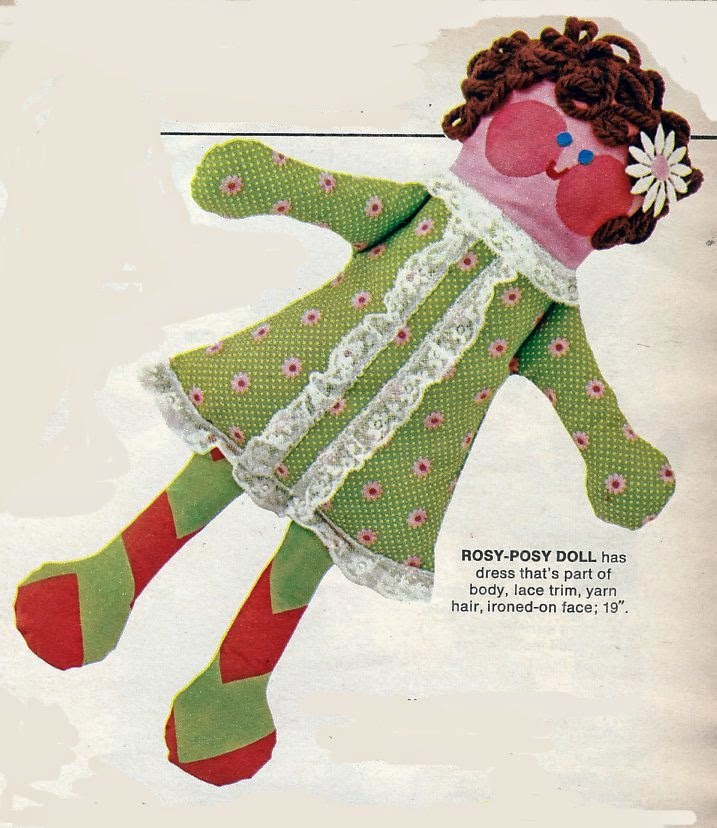
Rosy-Posy and Wide Eyed Suzy Dolls from Woman's Day (1968)

In the 1960s and '70s, Woman's Day magazine featured an article on inexpensive Christmas gifts to make in their November issue. Cloth dolls were always included. These two dolls, Rosy-Posy and Wide Eyed Suzy, were offered in the November 1968 edition. In addition, two Mother Goose dolls designed by Joan Russell were included in the same issue, with an order form to send away for patterns for the complete set of five.


19" Rosy-Posy is like a pancake doll, except that her front and back are pieced together from three separate fabrics first, then sewn together all at once. Her body and arms are made of print fabric to look like a dress, and gathered lace trim adds to the effect. The instructions call for brightly colored iron-on fabrics to be used for her facial features. I don't think these are widely available now, but with the advent of fusible web like Wonder Under and Stitch Witchery, any fabric can be used. Her hair is made of rug yarn.


Wide Eyed Suzy is a 12" pancake doll and meant to be made of felt, with glued-on eyes and mouth and embroidered yarn freckles and eyelashes. Her dress is also felt with appliqued felt dots, and she has yarn hair.


The patterns for both dolls are given as tiny grids which need to be enlarged to be used. With such simple designs as these, this method is easy enough, even without the use of a scanner or copier. These patterns would make great first sewing projects for young children.