Showing posts with label 1960s. Show all posts

Cloth Doll Patterns in 1960s Needlecraft Catalog

These cloth doll patterns were offered in an undated catalog named Needlecraft Patterns. This appears to be another incarnation of Reader Mail, Inc., a company that advertised all types of craft patterns in newspapers across the U.S. Because the catalog also offers knitting patterns for Barbie dolls, with photos of dolls from the early 1960s, that helps to date it. The 9" doll with wardrobe of clothes, the laundry bag doll and topsy turvy doll are both baseball head style. The Sleepytime Gal, 12" clown and Santa are sock dolls. The floppy cowboy doll is 44" tall.


The Mad Tea Party - Alice in Wonderland Doll Patterns by Joan Russell (1965)


The November 1965 issue of Woman's Day magazine featured The Mad Tea-Party, a set of cloth dolls of characters from Lewis Carroll's "Alice in Wonderland," designed by Joan Russell. The magazine included free patterns on tiny grids for you to enlarge, or you could order the set of full-size patterns by mail. The full-size patterns are on six 17" x 22" sheets of paper, with black and white illustrations. No size is given, but Alice looks to be about 14" tall.


The Mad Tea-Party includes Alice, the March Hare, the Dormouse, the Mad Hatter and the White Rabbit. The heads and torsos of the dolls are sewn in quarters, with two piece arms and legs, jointed with buttons. The maker is instructed to make Alice and the Mad Hatter from cotton, the White Rabbit and March Hare from wool, and the Dormouse from velveteen. They have appliqued and embroidered facial features. The Mad Hatter's nose is stuffed to give it dimension. The hair and tails are of yarn.


Each character, except the Dormouse, has a simple version of his or her outfit, well known from the classic illustrations by John Tenniel. Alice wears a short sleeved dress, a pinafore with two pockets, and felt shoes. The Mad Hatter wears a sleeveless shirt, corduroy pants, jersey jacket, velveteen hat, felt bow tie and shoes. The March Hare wears a sleeveless shirt with simple tie, and a jacket. The White Rabbit's outfit consists of a sleeveless shirt, vets, jacket and bow tie.


These simple patterns in Joan Russell's signature style are simple to make, and will delight fans of this classic story.


June Bride 15" Vintage Cloth Doll Pattern


June Bride is a 15" cloth doll from the booklet "Dolls Old and New," which includes several cloth doll patterns. There is no copyright date or publisher's name on the booklet, but it appears to have been printed circa 1970, though individual patterns may have been offered at an earlier date. This may be a publication of Reader Mail, Inc., the company responsible for Laura Wheeler, Marian Martin and Alice Brooks patterns, among others.


June Bride is a baseball-head doll with attached ears. Her arms and legs are sewn in place so she cannot sit. Her facial features are embroidered after stuffing. Her hair is worsted weight yarn. She has mitten hands and flat-soled feet.


June Bride's wedding gown is a very simple one, with the bodice and sleeves all of one piece. The bodice is trimmed with lace and buttons to give the illusion of a yoke. She has a veil, petticoat and bouquet, but no underpants or shoes.

June Bride would be a nice doll to display a miniature-sized version of your own wedding gown.


McCall's 7560 - Hillbilly Stuffed Dolls Pattern (1964)


McCall's Pattern #7560 makes three "Hillbilly" dolls - Paw who is 17" tall, and Shorty and Pearl, each 12" tall. Designed by Virginia Black, they were clearly inspired by the popularity of "The Beverly Hillbillies" television series which was the number one show in America at the time.


These dolls are made with an unusual method that calls for their heads to be made from either pink jersey knit fabric or a women's pink ankle sock (instructions are given for both); while the rest of their bodies are made from woven fabric such as broadcloth. Both the large and small dolls have applied noses, choice of embroidered or drawn features, quarter-seamed torsos, mitten hands stitched to indicate fingers, and crewel wool yarn hair. The main difference between Paw and the kids is their legs and feet; Pearl and Shorty have one-piece legs and feet cut from black fabric to resemble stockings, while Paw's bare feet are constructed separately and then applied to his legs. Paw also has a beard made from the same yarn as his hair.


The clothing of all three dolls is simple to make, with the patches added to the pieces before the side seams are sewn. Paw and Shorty have "suspenders" made from piping cord or heavy twine. The dolls' hats can be made from burlap, cotton crash (?) or an old finely-woven straw hat.

These dolls are charming characters which evoke the pop culture of their time. They would make a great gift for a fan of the Beverly Hillbillies or bluegrass music.


The Paw doll pictured below right was made from this pattern, although the maker used muslin for the entire doll, rather than using knit fabric for the head as the pattern suggests. Paw's companion (Maw?) is made from the same pattern. Either the maker created her clothing and hairstyle, or there is another version of this pattern out there somewhere that includes the lady doll.


The dolls are tagged from Blue Ridge Hearthside Crafts Cooperative in Sugar Grove, NC. They are charming and well made. You can read more about them here: https://www.etsy.com/listing/712167937/blue-ridge-crafts-hand-made-cloth.


Baby Dolls by Joan Russell for Woman's Day (1964)


This set of patterns, designed by Joan Russell, makes a chubby baby doll which can be varied with different facial features and hair colors, plus a wardrobe of clothes. It was offered to readers of Woman's Day magazine in 1964.


The pattern is described as making five different dolls, but they all use the same pattern pieces. They are made in baseball head style, but unlike most dolls with this construction, the front face piece is wide enough so that the face is flat and the head more square than round. The baby's arms (with stubby, separated fingers) and legs are stuffed separately and then attached.By varying the embroidered facial features and colors of yarn hair and appliqued fabric eyes, the maker is instructed to make the characters of Sleepy Head, Angel, Red Head, Cry Baby and Cherub. No size is given for the dolls, but they look like they would make up about 16" tall.


The pattern includes a complete wardrobe of clothes to sew, including a smocked dress and bonnet with bloomers; coat and hat; underwear, bib and blankets; one-piece pajama and nightgown with drawstring bottom; bunting; christening outfit with eyelet gown, coat and bonnet; plus knitting instructions to make a sweater, bonnet and booties.


Joan Russell's dolls are fairly simple to make, and the outfits have some interesting details, like the smocked and knitted pieces. This is a classic '60s cloth doll pattern.


Rosy-Posy and Wide Eyed Suzy Dolls from Woman's Day (1968)

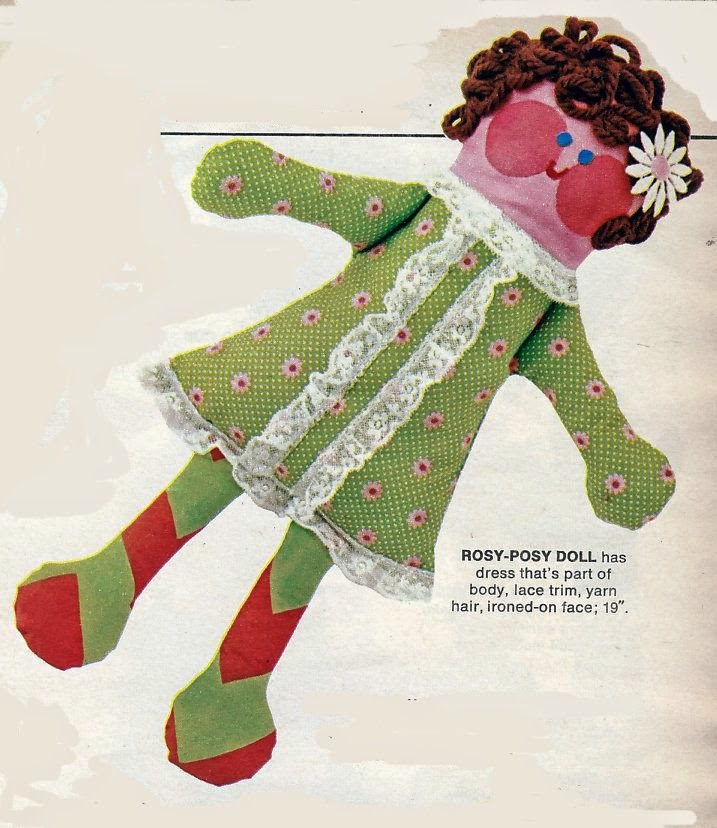
In the 1960s and '70s, Woman's Day magazine featured an article on inexpensive Christmas gifts to make in their November issue. Cloth dolls were always included. These two dolls, Rosy-Posy and Wide Eyed Suzy, were offered in the November 1968 edition. In addition, two Mother Goose dolls designed by Joan Russell were included in the same issue, with an order form to send away for patterns for the complete set of five.


19" Rosy-Posy is like a pancake doll, except that her front and back are pieced together from three separate fabrics first, then sewn together all at once. Her body and arms are made of print fabric to look like a dress, and gathered lace trim adds to the effect. The instructions call for brightly colored iron-on fabrics to be used for her facial features. I don't think these are widely available now, but with the advent of fusible web like Wonder Under and Stitch Witchery, any fabric can be used. Her hair is made of rug yarn.


Wide Eyed Suzy is a 12" pancake doll and meant to be made of felt, with glued-on eyes and mouth and embroidered yarn freckles and eyelashes. Her dress is also felt with appliqued felt dots, and she has yarn hair.


The patterns for both dolls are given as tiny grids which need to be enlarged to be used. With such simple designs as these, this method is easy enough, even without the use of a scanner or copier. These patterns would make great first sewing projects for young children.


Martha & George Washington Doll Patterns by Ella DeHart (1968)


Ella DeHart self-published many doll patterns in the 1960s and '70s. This pattern makes 12" George and Martha Washington dolls, with their complete outfits.


Martha Washington has a quarter-seamed head and torso, with separate bust pieces to be stitched on after her torso is stuffed. Her legs are shaped like heeled boots. She has mitten hands with stitching to indicate fingers. Her arms and legs are thread jointed. She has embroidered features and yarn hair.

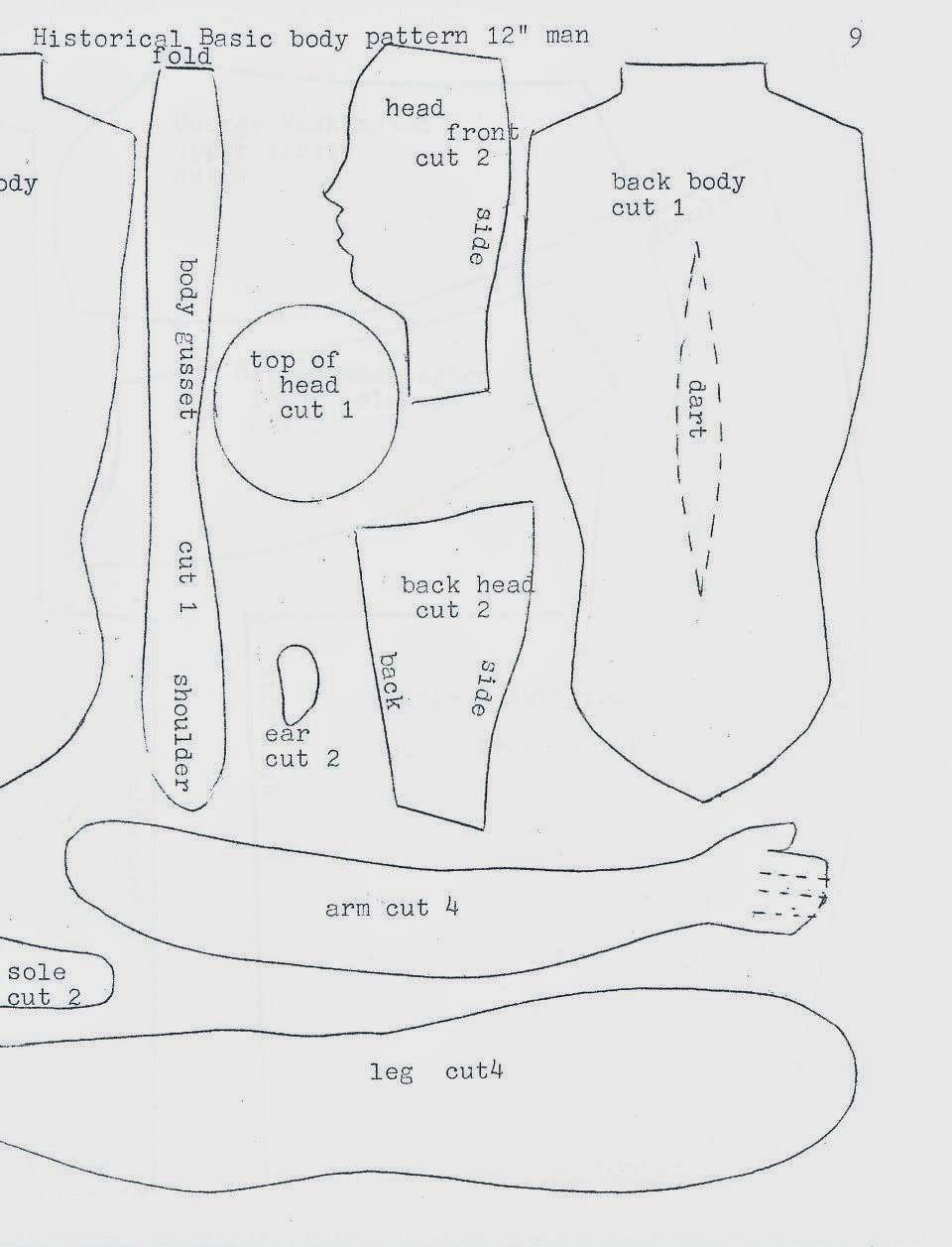
George has a somewhat different construction. His quarter-seamed head has a round pate piece and separate ears. His torso has a gusset that starts at one shoulder, goes down and around and up to the other shoulder. His arms and legs are thread jointed like Martha's. His hair may be a wig or yarn. The instructions call for both dolls to be made from felt.


Their clothing is detailed and mostly appropriate to the late Colonial / early Federal era in which they lived. Martha wears a dress with quilted underskirt and two petticoats. She also wears pantalettes, which were not introduced until after her lifetime. The instructions call for a bustle to be worn under the overskirt, in the middle of her back; the cover illustration instead shows a bustle on each hip, which would give the impression of panniers (side hoops), more appropriate to Martha's time, or at least to the way she is usually remembered. Her shoes are to be made of felt and cardboard, and she carries a fan you can make from paper and toothpicks.

George wears a shirt, stock (neckband) with lace jabot, knee breeches, hat, shoes and stockings. His suit and hat are to be made from felt. Personally I would skip the stockings and make his legs from white felt, as the maker is instructed to do for Martha.


Ella DeHart patterns are very interesting but she was notorious for the lack of detail in her instructions. You really have to know what you are doing to make one of her patterns. This one would be a nice challenge for someone who likes to make historical character dolls.

Beanie the Clown Doll - Idaho Bean Commission -1960s?


Beanie the Clown pattern was given away free by the Idaho Bean Commission. There is no date on the pattern, but it looks to be from the 1960s.


It doesn't say what size Beanie is, but based on similar dolls I have had, he's probably about 6" tall. His torso/legs are gathered at the top to attach to his head. He has no arms, just felt mittens sewn in to the side seams of his body. His feet are felt also. An illustration of his facial features is included, but it is left to the maker to decide how to apply them. Beanie has no hair. He is stuffed with beans (of course!)

Since his body is his costume, the only other clothing pieces are his hat and the ruffle around his neck, which are sewn in place.

There were other cloth and character dolls similar to Beanie made in the mid-20th century. Their simple construction made them popular bazaar items. The exhortations to eat beans ("Let a pot of Beans be cooking while you're sewing.") make this a fun advertising collectible as well as a cute pattern.

Ella's Original Doll Pattern #41: Cicely, Circa 1810 Bride Doll

Ella DeHart self published many doll patterns in the 1960s and '70s. Many, like this one, are Barbie-sized. Cicely is dressed as a bride in the Empire style of the early 19th century.


Cicely has a quarter-seamed head with ears, an hourglass torso with separate bust pieces to stitch over her body after stuffing, and a shapely bottom. She has stitching to indicate fingers. She is to be made of skin-toned percale, fine linen or any cotton. The maker is instructed to cut the head pieces on the bias to make the cheeks rounder. Hair can be darning thread, yarn or a wig; very little direction is given on this and style is left up to the maker. (A common hairstyle in this period was for the hair to be worn up, with little wispy curls around the face.)


Cicely's wedding outfit includes a gown with Empire waistline, pleated bodice, and overskirt with vertical gathers at the hemline; pantalettes and petticoat; veil, gloves and slippers. She should have a bouquet of tiny flowers. Although instructions call for the ensemble to be all in white, it should be noted that brides didn't always wear white at that time.


This pattern looks like it would be rather tricky to make, with a lot of detail on a relatively small doll. What do you think? Have you made one of Ella's patterns?


Little Women designed by Joan Russell for Women's Day, 1963


Four patterns to make dolls representing the characters from the classic novel, "Little Women," were issued by Women's Day magazine in November of 1963. The designer, Joan Russell, created many wonderful patterns for Women's Day in the '60s and '70s, but Meg, Jo, Beth and Amy are among her best, in my opinion. What I love most about these dolls is that each doll is an individual, with her own body pattern. Most mass-produced dolls of the March family girls use the same body, and often the same face for all four sisters, despite the fact that the characters at the beginning of the book range in age from 12 to 16. The patterns are printed on oversized sheets of plain paper. The whole package cost fifty cents.

The finished dolls range in height from 17.5" to 20". Their heads and torsos are pieced in quarters, with seams at the front, back, and each side. The dolls have stuffed lower arms with stitching to indicate fingers; the upper arms are left unstuffed. They have embroidered features and synthetic hair.

Each doll has two outfits. Amy and Beth each have a day dress and a nightgown. Amy has a cape and Beth a coat. Jo and Meg each have a day dress and a suit outfit of jacket, skirt and blouse. There are instructions to make undergarments for each of them. Meg has slippers while her sisters wear boots. Instructions to make wardrobe trunks are also included.


McCall's 7432 - 17" Mary Poppins doll


This great doll pattern was released in 1964 to tie in to Disney's "Mary Poppins" movie starring Julie Andrews.


The doll is 17" tall and is designed in a separated pancake style for easy construction. She has mitten hands and is jointed at the hips and shoulders. She has crewel wool yarn hair and embroidered features. A transfer is included for embroidering her face and the pattern on her carpetbag.


What makes this pattern special is her interesting outfit. Her "Nanny costume" consists of a long skirt, lace-trimmed "pettiblouse," full-length felt coat with pleated back seam, embroidered carpetbag, gloves and stockings, unusual felt hat and boots, and crocheted scarf.


For those who are tired of making the same old thing, this vintage pattern offers a breath of fresh air. It would be interesting to adapt the wardrobe patterns to try and make some of the other outfits from the movie for the doll to wear. The accessories, particularly the carpetbag, would be useful for other dolls as well.

I would love to hear from anyone who has made this pattern.

Design 7339 - 32" Baseball Head Boy doll pattern

This mail order pattern came in its original Alice Brooks envelope. There is no copyright date on the pattern, or postmark date on the envelope, but the zip code used in the address indicates it was mailed sometime after zip codes were introduced in the mid-sixties. This is a transfer pattern; unfortunately the ink from the transfer has bled through to other sections where the pattern was folded.

The pattern makes a baseball-head style boy doll, 32" tall, with embroidered features and "straw yarn" for hair and eyelashes. Because of the large size of the doll, two entire sheets are required for all of his body parts to fit. No clothing pattern is provided; instructions call for "discarded or outgrown" size 2 clothes for him to wear.

He is a cute boy with freckles and applied ears. His hands have separated fingers with the exception of the third and fourth fingers which are joined together. The eyelashes are another unusual touch. The maker is instructed to stiffen them with clear nail polish, if desired. Depending on the stuffing used, this doll may be very heavy. A large upholstery or mattress needle is recommended, with heavy string or rug cotton, to join his arms and legs to his body.

There are many patterns to make both a boy and girl doll, but very few that make just a boy by himself. Of course, a pattern for a girl in this size was also available.


Design 7083 - Doll Toaster Cover

I got this pattern in its original Alice Brooks envelope, ordered from the Hartford Courant, with a postmark date of 1961. It makes a doll toaster cover with the doll's head, torso and arms on a cardboard base that sits on the toaster, which is covered by her skirt.

The doll part of the pattern is a transfer; the pattern for her outfit is meant to be cut out and used as a tissue paper pattern. She has a very exotic-looking face with features that may be embroidered, painted or drawn with crayons(?). She will be about 7" from her waist to the top of her head. The instructions call for "straw yarn" for her hair. She is made with separated pancake construction and has mitten hands.

This pattern, with the same illustration, was also sold as #7073. I'm not sure if the pattern pieces are different at all; but the instructions are a little more detailed and the pattern is called a "Multi-Stamp Transfer Pattern."

I was amazed in researching this pattern to see how many different doll toaster cover patterns were produced. It must have been a fad at one time.