Showing posts with label lady. Show all posts

Elegant African Woman Cloth Doll by Marcella Welch (1993)


This very simple pattern makes a lady doll dressed in a traditional costume of West Africa. No finished size is given, but it looks like she would make up to be about 15" tall. The pattern was designed by Marcella Welch and appeared in the April 1993 issue of Doll World magazine.

She is a stump doll, meaning she has no legs, and her body is made from African print fabric to resemble a dress. The body is almost cylindrical, wider at the bottom with a circular base, and rounded at the top. Plastic pellets are used along with the fiberfill stuffing to give her some weight. She has slightly curved arms with only a suggestion of hands. Her head is spoon-shaped and has a wooden craft stick inserted to keep it erect. She has no hair or facial features.


This simple doll is beautifully accessorized with a lappa (wrapper) around her shoulders, and a gele (traditional headwrap). Gold cord forms her bracelets, neck rings and earrings. She has a beaded necklace as well, and carries a straw basket of fruit.


The step-by-step instructions are detailed, and the steps to wrap the gele correctly are illustrated. This would be an excellent project for a beginning sewer. The directions call for the accessories to be hot-glued in place, but they could be stitched instead if you prefer.

Mandy #883 - Vintage Black Cloth Doll Mail Order Pattern


Mandy is a mystery mail order pattern. No company or designer name, or date is on the pattern, just the number 883. The return address on the envelope is Needlework Dept., 220 Fifth Ave., New York 1, N.Y. This may be another branch of Reader Mail, Inc., the company responsible for Laura Wheeler, Marian Martin and Alice Brooks patterns, among others.


No size is given, but it looks like Mandy would make up to be about 17" tall. She is designed as a black doll, as the instructions call for her to be made from brown cotton material. Her body is separated pancake style, with the suggestion of fingers in the scalloped tips of her hands. Her facial features are to be embroidered in satin stitch and her hair is to be done all in French knots from "heavy black knitting worsted."


Mandy's outfit is in the stereotypical "mammy" style, with an apron over her dress and bandana over her hair. Ankle strap shoes and under pants complete her ensemble. If you want practice using the binding foot on your sewing machine, this is a good pattern to try - the sleeves, neckline, apron, shoes and bandana are all bound in bias tape, which adds interesting detail to an otherwise simple pattern.

Martha & George Washington Doll Patterns by Ella DeHart (1968)


Ella DeHart self-published many doll patterns in the 1960s and '70s. This pattern makes 12" George and Martha Washington dolls, with their complete outfits.


Martha Washington has a quarter-seamed head and torso, with separate bust pieces to be stitched on after her torso is stuffed. Her legs are shaped like heeled boots. She has mitten hands with stitching to indicate fingers. Her arms and legs are thread jointed. She has embroidered features and yarn hair.

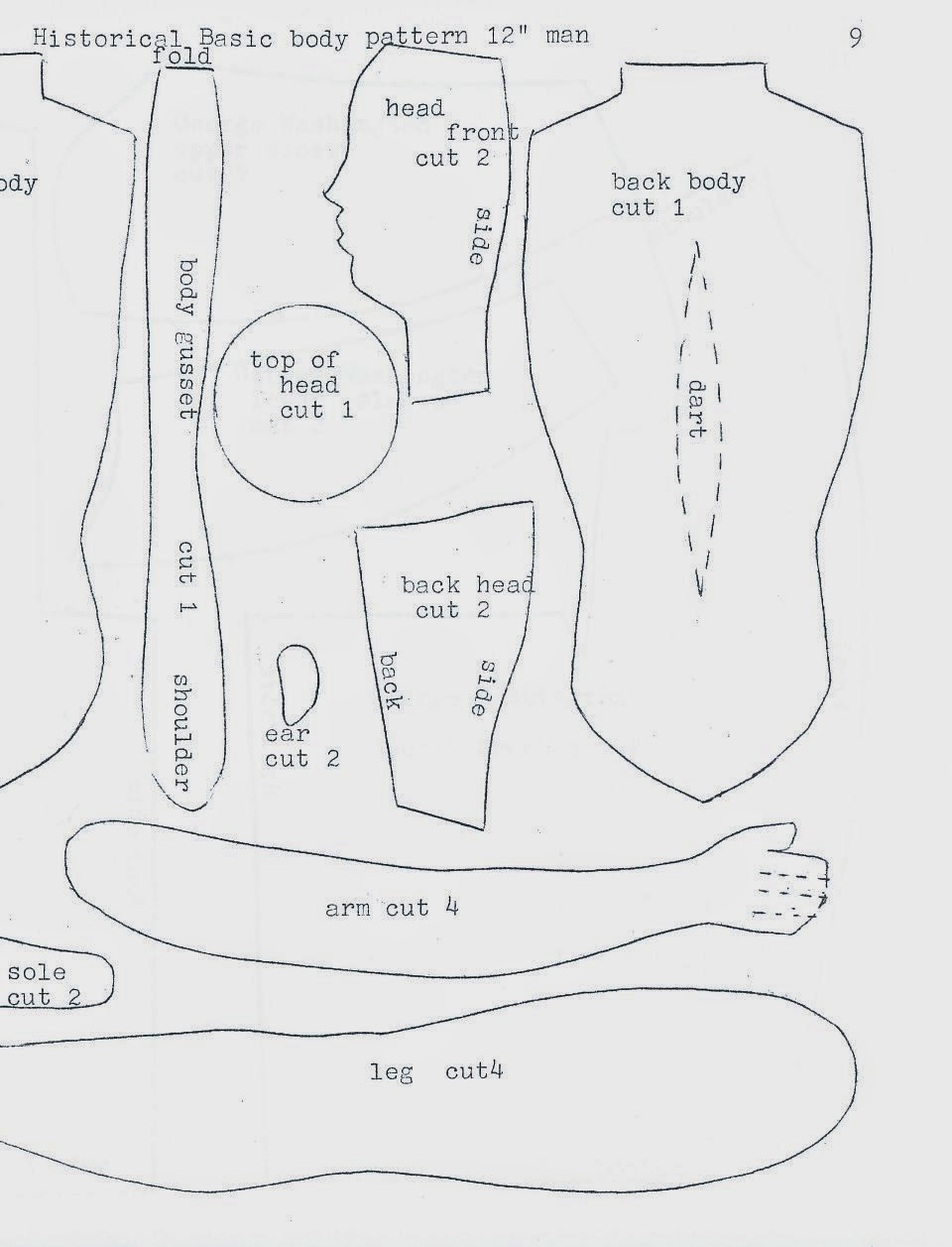
George has a somewhat different construction. His quarter-seamed head has a round pate piece and separate ears. His torso has a gusset that starts at one shoulder, goes down and around and up to the other shoulder. His arms and legs are thread jointed like Martha's. His hair may be a wig or yarn. The instructions call for both dolls to be made from felt.


Their clothing is detailed and mostly appropriate to the late Colonial / early Federal era in which they lived. Martha wears a dress with quilted underskirt and two petticoats. She also wears pantalettes, which were not introduced until after her lifetime. The instructions call for a bustle to be worn under the overskirt, in the middle of her back; the cover illustration instead shows a bustle on each hip, which would give the impression of panniers (side hoops), more appropriate to Martha's time, or at least to the way she is usually remembered. Her shoes are to be made of felt and cardboard, and she carries a fan you can make from paper and toothpicks.

George wears a shirt, stock (neckband) with lace jabot, knee breeches, hat, shoes and stockings. His suit and hat are to be made from felt. Personally I would skip the stockings and make his legs from white felt, as the maker is instructed to do for Martha.


Ella DeHart patterns are very interesting but she was notorious for the lack of detail in her instructions. You really have to know what you are doing to make one of her patterns. This one would be a nice challenge for someone who likes to make historical character dolls.

Ella's Original Doll Pattern #41: Cicely, Circa 1810 Bride Doll

Ella DeHart self published many doll patterns in the 1960s and '70s. Many, like this one, are Barbie-sized. Cicely is dressed as a bride in the Empire style of the early 19th century.


Cicely has a quarter-seamed head with ears, an hourglass torso with separate bust pieces to stitch over her body after stuffing, and a shapely bottom. She has stitching to indicate fingers. She is to be made of skin-toned percale, fine linen or any cotton. The maker is instructed to cut the head pieces on the bias to make the cheeks rounder. Hair can be darning thread, yarn or a wig; very little direction is given on this and style is left up to the maker. (A common hairstyle in this period was for the hair to be worn up, with little wispy curls around the face.)


Cicely's wedding outfit includes a gown with Empire waistline, pleated bodice, and overskirt with vertical gathers at the hemline; pantalettes and petticoat; veil, gloves and slippers. She should have a bouquet of tiny flowers. Although instructions call for the ensemble to be all in white, it should be noted that brides didn't always wear white at that time.


This pattern looks like it would be rather tricky to make, with a lot of detail on a relatively small doll. What do you think? Have you made one of Ella's patterns?